|
|
|
|
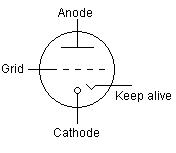
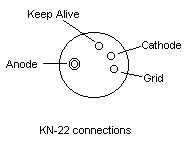
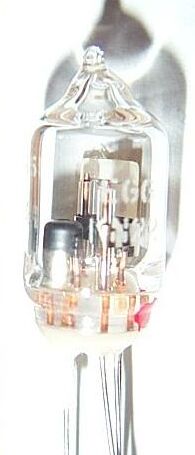
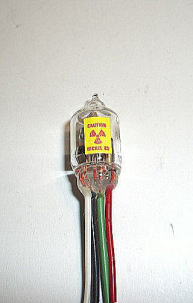
Krytrons are a highly specialized variety of cold cathode trigger tube. They were one of the first products developed by the US based company EG&G along with precision flash lamps. The Krytron has 4 electrodes, and is filled with a noble gas (the bulk gas is krypton, with several Penning gasses) at low pressure. A Krytron is distinguished among cold cathode trigger tubes for a variety of reasons. The Krytron is designed to switch moderately high impulse currents (up to around 3kA) and voltages (Up to around 5kV) in an arc discharge mode, compared to the usual glow discharge of the standard trigger tube. Also, and perhaps more importantly, the Krytron is able to turn on this arc discharge very rapidly, the reason being that it relies on an already present plasma to facilitate the conduction path, rather than waiting for the plasma to be formed as a result of priming. This plasma is created and sustained by a keep alive current between the keep-alive electrode and the cathode of the device. When the trigger is applied under the conditions of a high anode to cathode voltage, this plasma forms an easy path for the main conduction between anode and cathode. The fact that a conduction path is already established prior to triggering makes a huge difference in the commutation time of these devices compared to standard cold cathode trigger tubes. Commutation times below one nanosecond are achievable with Krytrons and the time lag between application of trigger and the commencement of switching may be less than 30ns with an optimized driver circuit. (Note this delay is largely due to the fact that the ionized path will need to spread from the keep alive terminal to the anode of the device). Compare this delay time to that seen in the standard trigger tube which is dependent upon many environmental factors and typically 3 or 4 orders of magnitude greater. Note that the variation in time delay exhibited by the Krytron is almost totally independent of environment, however the time delay may be reduced up to a point with increasing trigger voltage. Likewise the commutation time is generally decreased if the rise time of the trigger pulse is also decreased. Given identical trigger pulses however a Krytron will have a very similar time delay from one shot to the next. This variation is known as jitter and may be less than 5ns in optimal circumstances. A Krytron contains a source of beta radiation, Ni-63. The quantity in each device is less than 5 microcuries and presents no significant hazard. Usually the source is pulse welded to a piece of Nickel wire that is in turn welded to one of the electrode supports. The purpose of this source is to increase the reliability of the krytron by aiding the formation of the initial glow discharge between the keep alive and the cathode. This initial keep alive current is very much subject to environmental factors such as are seen in the formation of the glow discharge in standard trigger tubes, such as the hydrogen thyrotron. It is for this reason that a radioactive priming element is used, much as in the priming (thermal or ionized gas) source employed in a standard trigger tube (which is also occasionally a radioactive source). Krytrons typically come in a small glass envelope somewhat similar to a neon indicator bulb with more leads. Krytrons require a high voltage pulse (500V to 2kV) to be applied to the trigger electrode to fire successfully. This pulse is almost always generated by a pulse transformer fired by a capacitor discharge in the primary of the transformer (rather like a simple xenon strobe tube firing circuit). The krytron often has only a short life expectancy if used regularly (often as few as a couple of hundred shots). However when used within the appropriate parameters and well within the expected life time they are extremely reliable, requiring no warm up and being immune to many environmental factors to a large extent (e.g. vibration, temperature, acceleration). These properties, combined with the small size make the krytron ideal for use in the detonating circuitry of certain types of missiles and smart bombs. The krytron may be used directly to fire a high precision exploding bridge wire, or alternatively as part of the triggering circuitry for a triggered spark gap or similar ultra high current triggering device as used in exploding foil slapper type detonators and larger EBW (expolding bridge wire) circuits. Krytrons are used in firing circuits for certain lasers and flash tubes and also in some pulse welding applications, often as triggering devices for other larger devices such as Thyratrons and vacuum spark gaps (Sprytrons). They are also used in medical high power ultrasonic applications, such as kidney stone smashers (lithotripters). Also, you can follow this link for some of our other work on vacuum tube technology. Please
email [email protected]
with any questions. |
|||||||||||||||||||||||||||||||||||||||||||||||||||||||||||||||||||||||||||||||||||||||||||||||||||||||||||||||||||||
| Last Modified
May 29, 2020
|
||||||||||||||||||||||||||||||||||||||||||||||||||||||||||||||||||||||||||||||||||||||||||||||||||||||||||||||||||||||